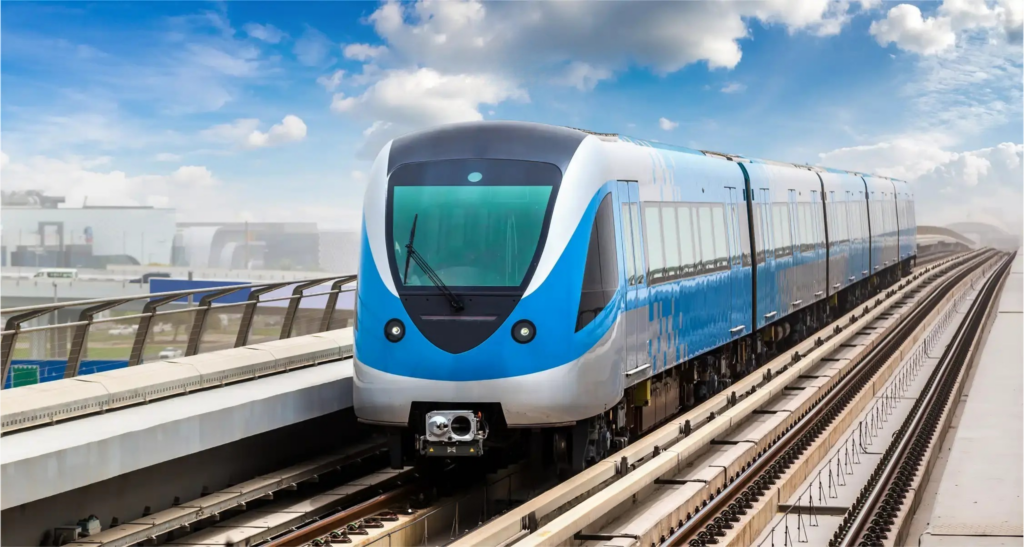
Dubai Metro Blue Line (2026): Route, Key Areas & Property Investment Opportunities
Table of Contents:
- Dubai Metro Blue Line Opening Date
- What Is the Dubai Metro Blue Line?
- Dubai Metro Blue Line Route & Stations
- Dubai Metro Blue Line Map (Planned Route Overview)
- Dubai Metro Blue Line Impact on Property Prices & Rentals
- 5 High-Impact Communities Along the Blue Line
- Risks & Considerations for Investors
- How to Invest in Properties Along the Blue Line
- Final Investor Insight: When Does Metro-Led Property Growth Actually Happen?
The Dubai Metro Blue Line is not just a transport project – it is an early-stage real estate catalyst.
In Dubai, major infrastructure upgrades have historically influenced buyer demand, tenant movement, and long-term pricing patterns well before completion. With the Blue Line scheduled for 9 September 2029, several connected communities are now entering the stage where accessibility improvements begin to shape investor attention.
For buyers and investors, the key question is no longer whether the Blue Line matters – it is which communities are likely to benefit most, where pricing inefficiencies may still exist, and whether the opportunity has already been priced in.
Key Takeaways:
- Expected opening date: 9 September 2029
- Total route length: 30km
- Planned stations: 14
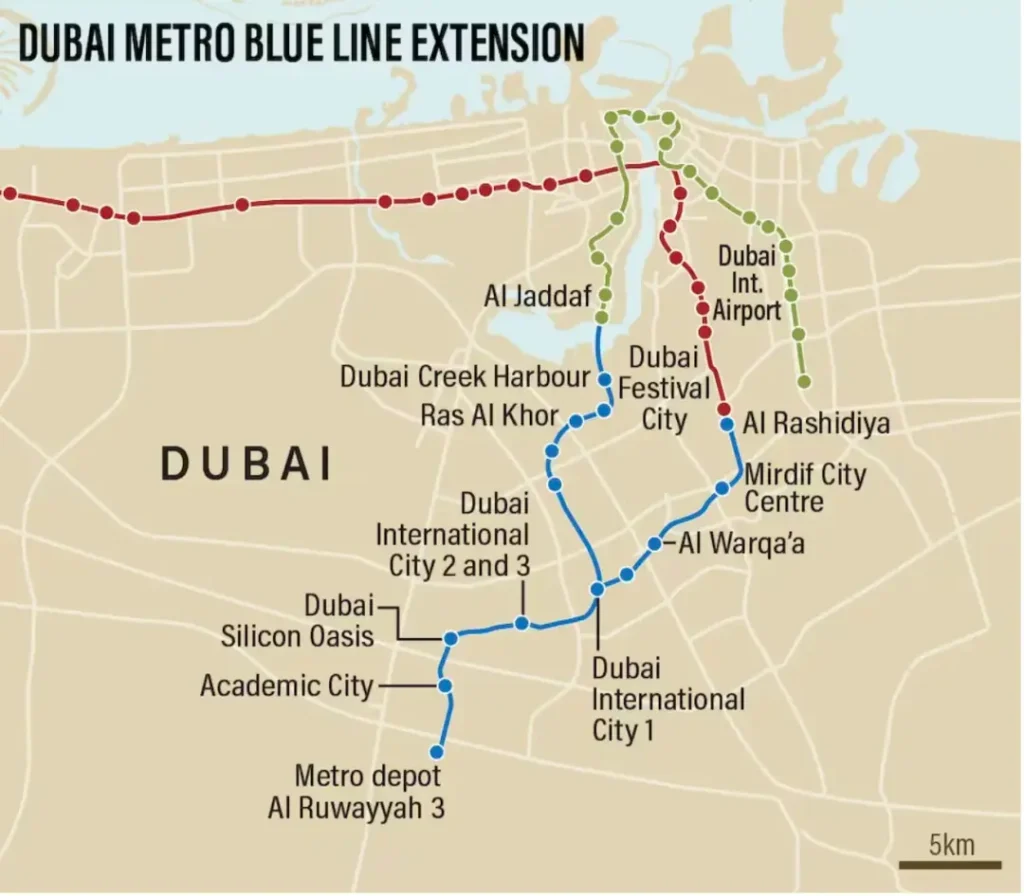
- Key areas on the route: Dubai Festival City, Dubai Creek Harbour, International City, Dubai Silicon Oasis, Academic City, and Mirdif
- Investor takeaway: infrastructure-led price growth often begins before completion, not after
The Cube Center also lists the documents required to apply for a two-year investor property visa in Dubai. To sponsor a family in Dubai, you’ll need:
- Title deed of a property in Dubai (properties issued from other Emirates or from DIFC are not accepted)
- Liability/No Objection Certificate (NOC) from the bank (if the property is mortgaged) or a payment statement from the developer (if the property is developer-financed)
- A clear passport copy (passport valid for more than 6 months).
- Old Emirates ID (if applicable).
- A high-quality applicant digital photo that matches the ICP specifications
- Health insurance from any insurance company in UAE
- Dubai Police issued a certificate of good conduct and behaviour addressed to the Dubai Land Department (for residents, use the Dubai Police mobile app; for non-residents, visit the Dubai Police station in Port Rashid).
- Applicants from the following countries Must Bring their National ID: Iran, Pakistan, Iraq, Libya and Afghanistan
Dubai Metro Blue Line Opening Date
The Dubai Metro Blue Line is planned to open on 9 September 2029.
Approved in late 2023, the project forms part of Dubai’s broader long-term mobility and urban expansion strategy. As with any large infrastructure development, timelines can evolve, but the Blue Line remains one of the city’s most important transport projects tied to future population growth, commuting efficiency, and transit-oriented development.
What Is the Dubai Metro Blue Line?
The Blue Line will be the third major metro corridor in Dubai, following the Red Line (opened in 2009) and the Green Line (opened in 2011).
Dubai Metro Blue Line Key Specifications:
- Total Length: 30km
- 15.5km underground
- 14.5km elevated
- Stations: 14 (9 elevated, 5 underground)
- Design Highlights:
- First 1.3km over-Creek metro bridge
- Iconic stations at Dubai Creek Harbour and Dubai Silicon Oasis, designed by Skidmore, Owings & Merrill (SOM)
- Capacity: Up to 320,000 passengers per day
- Integration: Planned interchanges with the Red and Green Lines at Centrepoint, Creek, and International City.
Dubai Metro Blue Line Impact on Property Prices & Rentals
Dubai’s real estate market has repeatedly shown that major transport infrastructure can influence both property values and rental demand, especially when it materially improves accessibility.
Red Line experience: Areas such as Dubai Marina and JLT saw strong long-term value growth after metro connectivity improved, although that growth was also influenced by broader market expansion and area maturity.
Green Line experience: Districts such as Deira and Bur Dubai benefited from stronger accessibility and sustained rental demand.
The Blue Line may follow a similar pattern, but the impact is unlikely to be uniform across all locations. In many cases, pricing begins to adjust before operations start, as investors move early in anticipation of future connectivity.
5 High-Impact Communities Along the Blue Line
1. Dubai Festival City – Waterfront Living with Metro Access:
Dubai Festival City is one of the more established communities on the route, which means the Blue Line may reinforce existing appeal rather than create it from scratch.
- Direct metro access to Downtown and Business Bay
- Strong appeal to end-users and long-term tenants
- Property values expected to rise by up to 15–20% leading up to 2029
2. International City – From Affordable to Transit-Connected:
International City may represent one of the clearest transformation plays along the Blue Line, because future metro access directly addresses its biggest historical weakness: connectivity.
- Three new stations plus an interchange hub
- Improved tenant quality and near-full rental occupancy
- Values could increase 20-25% as accessibility improves
3. Dubai Silicon Oasis – Free-Zone Hub Becomes Transit-Oriented
Dubai Silicon Oasis already has a strong residential and commercial base, and the Blue Line could make it materially more attractive to professionals who previously relied on road-based commuting.
- Metro connectivity strengthens appeal to professionals
- Rental yields forecast to rise from ~6% to ~7.5%
- Strong mid-income demand base
4. Academic City – Student Housing Opportunity:
Academic City is less about short-term speculation and more about long-term utility, particularly if improved connectivity strengthens demand for student housing, staff accommodation, and nearby rental stock.
- Metro access could halve commute times
- Rising demand for student housing and staff accommodation
- Attractive for build-to-rent and co-living investors
5. Mirdif – Family-Focused Community with New Connectivity:
Mirdif is an established end-user-driven area, so the Blue Line may enhance convenience and stability more than it creates rapid speculative upside.
- Improved metro access increases end-user appeal
- Rental demand expected to strengthen, especially for villas and townhouses
- Long-term stability over speculative growth
Risks & Considerations for Investors
While the Blue Line presents a compelling long-term opportunity, investors should remain disciplined:
Timeline risk:
Large infrastructure projects can face delays, which may affect short-term expectations.
Hype pricing:
Not every asset near a future station will be undervalued. Some projects may already reflect speculative pricing.
Supply risk:
Certain submarkets may face temporary oversupply, which can limit price growth even if connectivity improves.
Execution risk:
The strongest outcomes are likely to come from careful asset selection, realistic entry pricing, and a long enough holding period.
How to Invest in Properties Along the Blue Line
Off-plan:
Entering early near future stations may offer upside, but only where launch pricing remains reasonable.
Secondary market:
Ready properties in areas such as International City and Mirdif may offer better visibility on tenant demand, actual rents, and live pricing.
Financing:
Both traditional mortgages and structured payment plans can play a role, depending on risk tolerance and holding strategy.
Due diligence:
Investors should assess realistic yields, competing supply, infrastructure timing, and fair market value before committing.
Final Investor Insight: When Does Metro-Led Property Growth Actually Happen?
Before concluding, it’s important to understand how infrastructure-driven price growth typically unfolds in Dubai:
Infrastructure-led price growth does not usually begin when a metro line becomes operational. In practice, real estate markets tend to move in phases:
Early phase (5-7 years before completion):
Pricing can still be inefficient, with the highest potential upside but also greater uncertainty around execution, timelines, and demand.
Mid phase (2-4 years before completion):
Market awareness increases, infrastructure progress becomes more visible, and property values may begin to adjust more meaningfully.
Late phase (0-2 years before completion):
A larger portion of the expected upside may already be priced in, reducing the margin for error and limiting short-term gains.
As of 2026, the Dubai Metro Blue Line appears to sit in the early-to-mid transition phase. This means selective opportunities may still exist, particularly in communities where future connectivity is meaningful but not yet fully reflected in current pricing.
In Conclusion:
The Dubai Metro Blue Line is more than a transport expansion. It is a long-term urban infrastructure project that may influence demand, accessibility, and pricing across several eastern and north-eastern Dubai communities over the years ahead.
For investors, the opportunity is not simply to buy near a future station. It is to identify which areas are likely to benefit meaningfully, which assets are still reasonably priced, and where future connectivity may improve long-term tenant and buyer demand.
For tailored guidance, LYM Real Estate can help assess which Blue Line communities align best with your budget, timeline, and investment strategy.